Woodbridge Junior School
Happy Children Inspired to Learn
English
Summer 2
Writing
Overview and Outcomes:
This is a three-week Writing Root using the film (which can be found online) and text of Varmints by Helen Ward and Marc Craste. The sequence of learning starts with children entering the classroom to find seeds and flowers mysteriously left with an urgent letter of appeal from the main protagonist in the text, urging children to look after them and learn all they can about these gifts. Children will go on to plant the seeds and write instructions about the process, collecting subject-specific vocabulary as they go. Children will also dissect the flowers left behind, identifying and labelling the various parts and explaining their various roles in reproduction and pollination. Children will be given opportunities to describe flowers, write letters and make speeches to a secret society of gardeners who plan to change the world through the power of nature. This series of lessons culminates in children writing an explanation text about the life cycle of a plant with a clear structure.
Synopsis of Text:
Once, the only sounds to be heard were the buzzing of bees in the grass, the murmuring of moles in the earth, and the song of birds in the sky. These warmed the hearts of those who cared to listen - until the others came to fill the sky with a cacophony of noise. With dramatically lit artwork and a spare, intriguing text, Varmints tells of a pastoral world in need of protection and of the souls who love it enough to ensure its regeneration.

Reading
The Wild Robot
This is a 15-session Literary Leaf for The Wild Robot by Peter Brown, covering all aspects of the Key Stage 2 content domain. Children will follow the journey of the Rozzum Unit 7137 as she learns and develops on a strange, remote and mysterious island. Children will gain experience of answering a range of inference questions, focussing on impressions, character’s feelings, relationships and motivations. They will explore how protagonists change over time by mapping out character arcs and will also gain experience of summarising key plot points.
Synopsis of Text:
When robot Roz opens her eyes for the first time, she discovers that she is alone on a remote, wild island. She has no idea how she got there or what her purpose is – but she knows she needs to survive. After battling a fierce storm and escaping a vicious bear attack, she realises that her only hope for survival is to adapt to her surroundings and learn from the island's unwelcoming animal inhabitants. As Roz slowly befriends the animals, the island starts to feel like home - until, one day, her mysterious past comes back to haunt her.
From bestselling and award-winning author and illustrator Peter Brown comes a heartwarming and action-packed novel about what happens when nature and technology collide. By turns funny, moving, surprising and dramatic, this is a novel that is as thought-provoking as it is enchanting.

Summer 1
Writing
Weslandia
This is a three-week Writing Root based around the book Weslandia by Paul Fleischman. It begins with children creating a shelter for their own civilisation, as a hook to create engagement with the text. The first part then continues with children making predictions, describing Wesley’s character and eventually retelling the story in their own words. In the second part, children begin by creating a non-chronological report, published as a brochure for Weslandia itself, using planning models and information from and inferred from the text. In the final part, children create their own civilisation, based on Weslandia. Grammar and spelling objectives are embedded throughout.
Synopsis of Text:
Enter the witty, intriguing world of Weslandia! Now that school is over, Wesley needs a summer project. He’s learned that each civilisation needs a staple food crop, so he decides to sow a garden and start his own – civilization, that is. He turns over a plot of earth, and plants begin to grow. They soon tower above him and bear a curious-looking fruit. As Wesley experiments, he finds that the plant will provide food, clothing, shelter, and even recreation. It isn’t long before his neighbors and classmates develop more than an idle curiosity about Wesley – and exactly how he is spending his summer vacation.

Reading
The Humans
This is a 15-session Literary Leaf for The Humans: Ancient Civilisations and the Astonishing Things they Taught Us by Jonny Marx and Charlie Davis. Spanning all of history's known ancient civilisations, children will compare achievements, stories, language, myths and more from each era. Along the way they will develop their skills of retrieval, inference, summarising and comparing to complete activities, as well asking and answering questions and debating important points like 'what really have been the greatest inventions of all time?'
Synopsis of Text:
We chose this book as a Literary Leaf to complement texts under the theme 'Exploration & Discovery' on the Literary Curriculum, although it would also be a brilliant text to study in its own right. The book showcases the greatest achievements of ancient civilisations, peoples and iconic figures from history. From the Nubians to the Native Americans, and the Akkadians to the Aztecs, our predecessors have pioneered a plethora of wonderful and wacky inventions, technologies and practices. They've constructed monumental buildings and sprawling cities, created languages, modes of transport, art, medicines, music, stories, myths and more. With this book delve into the past and discover what humankind accomplished in the centuries and millennia since the first civilisations were formed....

Spring 2
Writing
Tar Beach
This is a three-week Writing Root using Tar Beach by Faith Ringgold. Children will explore the theme of ‘freedom’ and do so by creating their own poems. This will lead to a class performance with a particular focus on using repetition and rhythm. Once they have finished the story, children will receive a letter from the BBC asking them to write a script for the (hypothetical) upcoming movie version. Children will learn the various skills associated with script writing, writing dialogue and stage directions, including writing in present tense, using brackets, contractions and noun phrases. Children will finally publish an act from their script on BBC-headed paper and, in a small group, perform their scripts in front of an audience.
Synopsis of Text:
Cassie Louise Lightfoot has a dream: to be free to go wherever she wants for the rest of her life. One night, up on "tar beach," the rooftop of her family's 1939 Harlem apartment building, her dreams come true. The stars lift her up, and she flies over the city, claiming the buildings and the city as her own.
As Cassie learns, anyone can fly. "All you need is somewhere to go you can't get to any other way. The next thing you know, you're flying among the stars."
Children will delight in the universal dream of mastering one's world by flying over it. A practical and stunningly beautiful book.

FarTher
This three-week Writing Root begins by introducing the concept of dreams and how important they are in our lives. It continues by exploring the text through a range of activities that include explicit grammar teaching, opportunities for shorter written outcomes and book talk. Children create a story-map of the key events from the book to write a sequel and create a set of instructions to describe how their own flying machine works. Children finish by writing a longer story about an adventure in a sequel to the text.
Synopsis of Text:
A young boy, bewitched by his father's unrelenting passion to fly; a desperate craving that absorbs his every waking minute, finds himself entranced by the dream. When his father goes to war and does not return, it seems the spell is broken. Much later, the boy, now a young man, finds himself drawn once more to his father's drawings and failed experiments. Finally able to make his father's dream a reality, he flies. Will his own son be visited by this unrelenting passion?

Reading
The undefeated
This is a 15-session Literary Leaf for The Undefeated by Kwame Alexander and Kadir Nelson which covers all aspects of the Lower Key Stage 2 content domains. Children will begin by examining their understanding of black history in America and how their previous knowledge fits with new historical facts they are presented with. Through the series of lessons, children will consider definitions of key terms in context and discover poetic conventions and how they often link with music. There will be opportunities for children to practise answering retrieval, inference and summarising questions, as well as to express their opinions about the particular events presented through the text. There are also extension tasks which could lead to additional writing outcomes.
Synopsis of Text:
We chose this text as a Literary Leaf as it presents children with an essential opportunity to study a particular period in black history. This is a powerful and important ode to black history: the strength and bravery of everyday people and the grit, passion, and perseverance of some of the world's greatest artists, athletes, and activists. With references to lyrics and lines originally shared by our most celebrated heroes, this poem digs into the not-so-distant past to underline the endurance and spirit of those surviving and thriving in the present.

Annie Lumsden: The Girl from the Sea
This is a 15-session Literary Leaf for Annie Lumsden, the Girl from the Sea by David Almond, covering all aspects of the Key Stage 2 content domain. Children will explore Annie's watery world and follow the characters on their journey of discovery, beginnings and belonging. Along the way, they will analyse the motivations for the characters' decisions and track how their behaviour changes over time. Children will study the language choices made by the author, make predictions, explain their impressions and summarise the story by writing imagined chapter headings. There are also opportunities to study the work of illustrator Beatrice Alemagna and write book reviews so that children can share their thoughts about the story with others.
Synopsis of Text:
This beautifully written and illustrated story tells the tale of Annie Lumsden and her artistic Mam who live in a shack by the fictional Stupor Bay in the north of England. Annie struggles socially and academically at school and is asked to change to a school far from home in the city. Soon afterward, she suffers from mysterious falls and episodes which the doctors can’t understand. During these falls, she finds herself transported to underwater worlds ‘of coral and shells and beautifully coloured fish’. Annie is content living with her mother by the sea but is also intrigued by her dreams and thinks these might be a clue to her origins and the mystery of her identity.

Spring 1
Writing
Granny came Here on the Empire Windrush
Our second unit is a three-week Writing Root based around the book Granny Came Here on the Empire Windrush by Patrice Lawrence. It begins with children entering the classroom to find a mysterious suitcase. In the suitcase, they will find clues not just to the individual journey of Granny but also to the overarching topic of the Windrush Generation. Children will go on to write about their personal heroes and why they admire certain people, including those figures who travelled on the Empire Windrush in 1948 or those descended from this heroic generation. Children will write in role as Granny, writing a postcard and making a diary entry. They will also help Ava write a speech about why she admires Granny and why it is important we remember and pay tribute to this generation. Vocabulary and skills explored will culminate in children writing a factual report about the Windrush heroes and their struggles, successes and contributions to British life. There are recommendations within the Writing Root for useful texts, websites and podcasts to help children to research this topic further.

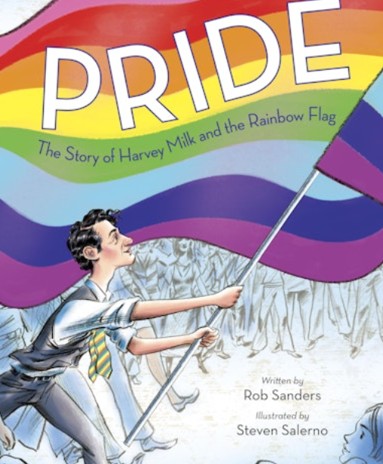
Pride
Our first unit is a three-week Writing Root based around the book Granny Came Here on the Empire Windrush by Patrice Lawrence. It begins with children entering the classroom to find a mysterious suitcase. In the suitcase, they will find clues not just to the individual journey of Granny but also to the overarching topic of the Windrush Generation. Children will go on to write about their personal heroes and why they admire certain people, including those figures who travelled on the Empire Windrush in 1948 or those descended from this heroic generation. Children will write a postcard in role. They will also help Ava write a speech about why she admires Granny and why it is important we remember and pay tribute to this generation. Vocabulary and skills explored will culminate in children writing a factual report about the Windrush heroes and their struggles, successes and contributions to British life. There are recommendations within the Writing Root for useful texts, websites and podcasts to help children to research this topic further.
Spring 1
Reading
The Star of Ishta
Our second unit in reading is a 15-session Literary Leaf for Tamarind and the Star of Ishta by Jasbinder Bilan which covers all aspects of the Lower Key Stage 2 content domains. Children will begin by considering the setting for the story and exploring the similarities and differences between the UK and India as presented in the text. Throughout, there will be plentiful opportunities for children to answer retrieval and inference questions presented in different formats, as well as defining new vocabulary in context, predicting, sequencing and summarising. The series of lessons culminates in children considering the significance of various items in the story.
Synopsis of text:
Tamarind never knew her Indian mum, Chinty, who died soon after she was born. So, when she arrives at her ancestral home, a huge mansion in the Himalayas surrounded by luxuriant gardens, she's full of questions for her extended family. But instead of answers, she finds an ominous silence - and a trickle of intriguing clues: an abandoned hut, a friendly monkey, a glowing star ring, and a strange girl in the garden who calls herself Ishta. Slowly, Tamarind unravels a mystery at the heart of who she is...
The Last Firefox
Our first text is a 20-session Literary Leaf for The Last Firefox by Lee Newbery, covering all aspects of the Lower Key Stage 2 content domain. Children will follow Charlie and his new companion Cadno on a journey of bravery, friendship and discovery. They will make predictions about the characters and plot, make inferences about characters' behaviours and motivations and explore the impact of language choices on the reader. Through whole class and small group discussion, children will summarise key events and explore the themes arising within the text before writing a final review which could appear on the book cover.
Synopsis of Text:
Between bullies at school and changes at home, Charlie Challinor finds life a bit scary. And when he's made guardian of a furry fox cub called Cadno, things get a whole lot scarier. Because Cadno isn't just any fox: he's a firefox - the only one of his kind - and a sinister hunter from another world is on his trail. Swept up into an unexpected adventure to protect his flammable friend, Charlie's going to need to find the bravery he never thought he had, if he's going to save the last firefox.

.jpg?v=1791064661)
Autumn 2
Writing
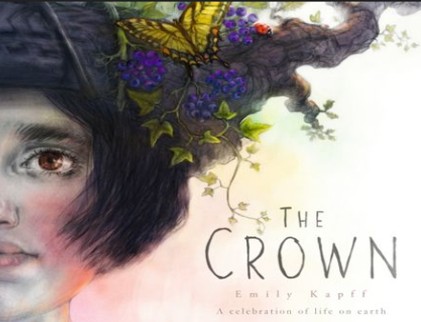
The Crown
Our final unit of 2025 is a three-week Writing Root using The Crown by Emily Kapff in which children begin by making inferences about a character from the story. Responding to an urgent request for help, they use natural and craft materials to create ‘glorious crowns’ which they then go on to describe using the present perfect tense and expanded noun phrases using prepositions. They consider the emotions of the main character through the form of diaries and build on emotive and figurative vocabulary through writing descriptive poems. Speech (and speech punctuation) is taught explicitly as part of an interviewing task. This Writing Root builds to the children writing individual information texts about some of the natural wonders of nature we can find in our world and how we can look after them. It culminates in the children putting their outcomes together to create a class ‘Book of Wonder’ information book.
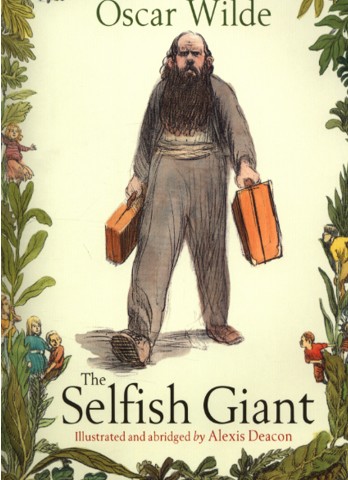
The Selfish Giant
Our first unit is a three-week Writing Root for The Selfish Giant by Oscar Wilde in which children will explore the text through a range of immersion and engagement activities and will write a range of texts, including diaries, letters, adverts, reports, and their own versions (narratives).
Reading
The Firework Maker's Daughter
This is a 14-session Literary Leaf for The Firework Maker's Daughter by Phillip Pullman in which children begin by investigating vocabulary and the effect it is has in particular contexts, as well making inferences about characters' actions and motives.
Synopsis of Text:
We chose this book for a Literary Leaf as it is a classic and we adore the language Phillip Pullman uses here. There is also a playscript version which we would recommend looking at with a group to identify how the narrative has been converted into direct speech.
Lila is a firework-maker’s daughter, who desperately wants to follow in her father’s footsteps. Lalchand is her father, who believes that, despite her talents, it is not a job for a girl. Lila can’t accept her father’s decision, so she goes off on a quest to face the Fire-Fiend and collect the Royal Sulphur she needs to be able to make the finest fireworks. On her journey she encounters pirates, wild animals and rocky mountains. Finally, she has to walk on fire to discover the secrets she needs to follow her passion. Luckily, she is trailed throughout by her friend Chulak, and Hamlet the sometimes-billboard, royal elephant, who save her from the flames with magic water. On their return, Lila and Lalchand have to prove that they are the very best firework-makers one more time, in order to save Lalchand from death.
Poems from a Green and Blue planet
This is a 15-session Literary Leaf for Poems from a Green and Blue Planet, collected by Sabrina Mahfouz, covering all aspects of the Lower Key Stage 2 content domain. We thought this text would make a perfect text for a Literary Leaf because of the opportunity to study a broad range of poems collected under one the theme - Planet Earth. Children will study the structure, rhythm and language choices of a variety of poets and prepare poems to read aloud and perform. They will make comparisons between the characterisation and differing 'voices' of a hurricane and an earthquake, and explore nonsense poetry with Edward Lear. There will also be opportunities to study poetry conventions such as personification, metaphor and rhyme.
For this Literary Leaf, we have chosen to use a selection of poems based on the theme of water and the sea to tie in with the Writing Root for Shackleton’s Journey. The rest of the book can be read and enjoyed for pleasure if time is limited.
Synopsis of Text:
This is a beautiful collection of poems which takes you on a journey around our wonderful green and blue planet, from mountaintops to ocean floors. Organised into themes linked to different elements, poems are gathered under the headings ‘Sun shines’, ‘Wind blows’, ‘Water flows’, ‘Earth spins’, ‘Fire leaps’, ‘Life grows’, ‘Ice chills’ and ‘Moon rises’. The collection includes both classics and newer creations in a range of forms from proverbs and haikus, free-verse to sonnets and rap to the Romantics. Children and teachers will enjoy dipping in and out and exploring poems by familiar and newer voices.


Autumn 1
Writing
We will start the new term with a three-week workshop to consolidate our grammar and punctuation skills. We will then be following the Literacy Tree approach in our school Writing curriculum using recommended texts to inspire and produce quality writing.
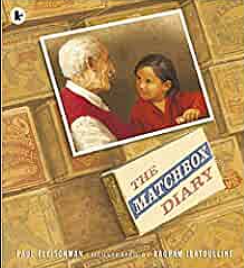
Our first text is ‘The Matchbox Diary’ by Paul Fleischman. The children will discover a set of matchboxes containing some of the mementoes from the story. After writing predictions about what the objects might relate to, the children listen to the story in stages. They make inferences about why the great-grandfather and his family went to America, explore vocabulary and write in role. After taking part in a freeze-framing activity, they write a conversation between two migrants on board the ship to America. They will research two famous landmarks - Ellis Island and the Statue of Liberty - before timelining the main character’s life story. Following this, the children write a biography about the great-grandfather who made his journey to America all those years ago.
We will continue to practise our handwriting and spelling skills using the ‘Penpals for Handwriting’ and ‘No Nonsense Spelling’ schemes.
Reading
For our Reading sessions, we will be following the ‘Literacy Leaves’ approach from Literacy Tree. Using quality texts, our aim is to create and nurture a love of reading whilst at the same time enabling children to develop a range of age-related reading skills through a variety of tasks and activities.
This term our chosen books are as follows:
‘The Lion, The Witch and the Wardrobe’ by C.S. Lewis. In this well-loved classic, we meet a family of children, evacuated to their strange uncle’s house which proves to be a great place to play hide-and-seek. But then the children discover the wardrobe is a portal to another world, a place in perpetual winter ruled by The White Witch. Just when all seems lost, Aslan – the Great Lion - returns, bringing with him a sense of hope and safety and changing the lives of the four siblings forever.
‘Fairytales Gone Bad: Zombierella’ by Joseph Coelho. The first in a funny, deliciously dark, three-part series of twisted classics, written in verse by award-winning poet Joseph Coelho and illustrated by Freya Hartas. A yellow moon hangs in a satin sky the night Cinderella, barefoot and in hand-me-downs, slips at the top of the stairs ... and dies. But not for long. The Shadow of Death arrives to breathe life back into her bones and, for three nights only, Cinderella goes forth as ZOMBIERELLA. With her skin as cold as ice and her faithful horse Lumpkin back by her side, can she seek revenge on her three cruel, fake sisters, once and for all?

.png?v=1791064661)
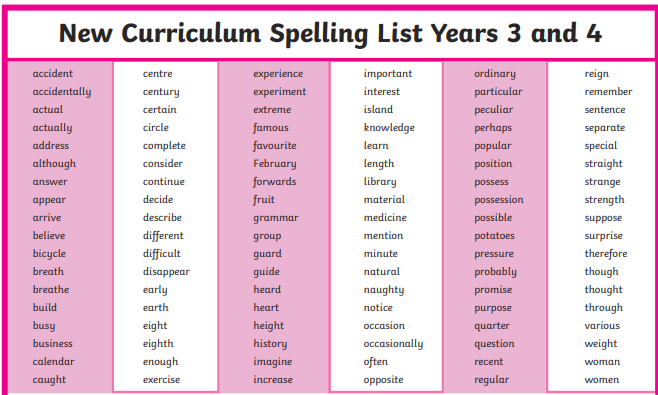
This half term we will continue our spelling journey by developing our knowledge of suffixes and prefixes and learning new spelling patterns to help us in our writing.
The spelling words to learn set by the National Curriculum can be seen below. This is a list of words to learn by the end of year 4.